Skip to product information
1 of 1

Vancouver Rare Plants

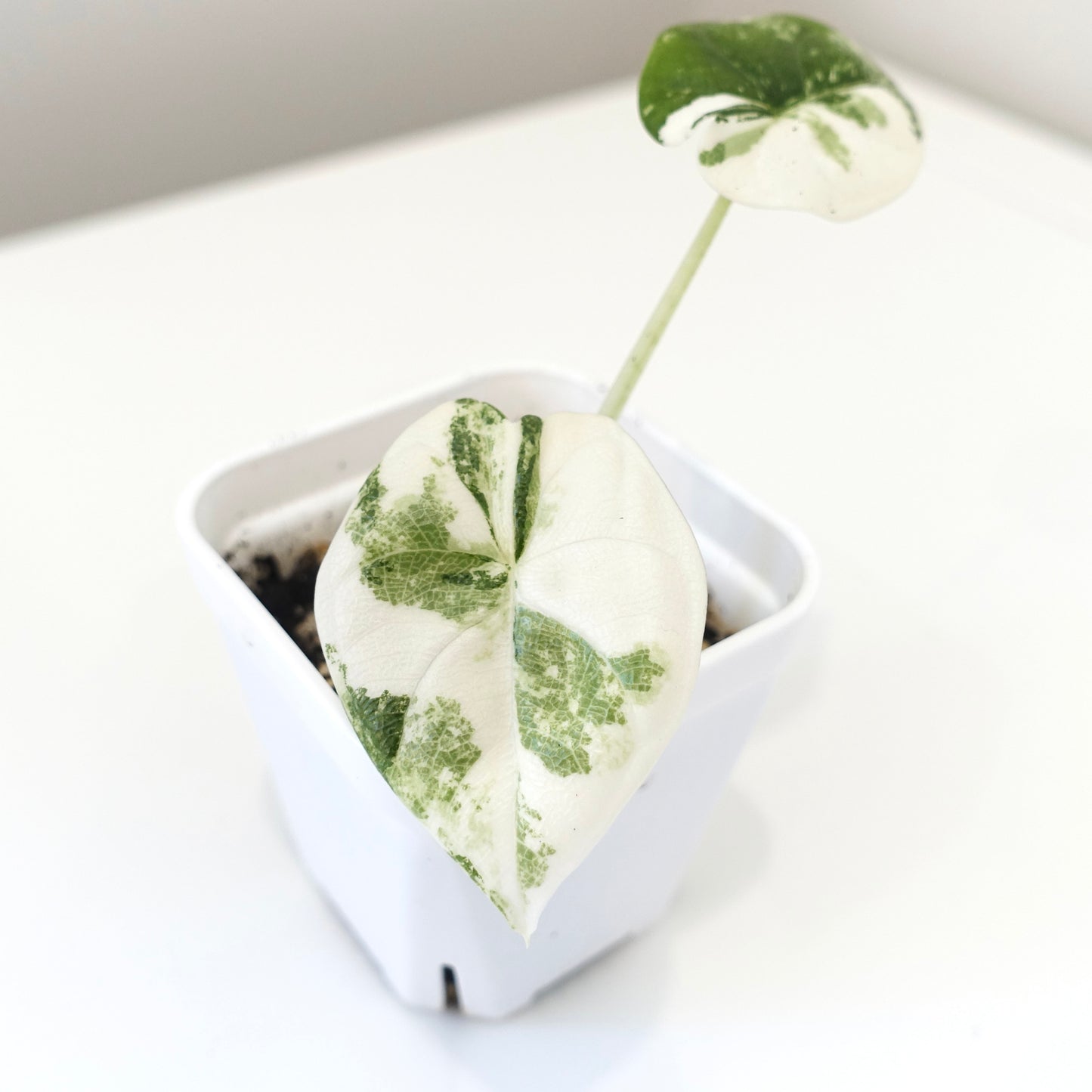
Alocasia Melo Albo - 001

Alocasia Melo Albo - 001

Regular price $119.99 CAD
Regular price Sale price $119.99 CAD
Sale Sold out

Low stock: 1 left

There are rare plants. There are texturally extraordinary plants. And then, very occasionally, there is a plant that is both simultaneously — and in which the combination feels almost impossible. The Alocasia Melo Albo is that plant. Crisp white-to-alabaster chimeric variegation layered onto one of the most sculpturally distinctive leaf surfaces in the entire plant kingdom — the deeply corrugated, stone-like, almost geological foliage of Alocasia melo, a species found nowhere on Earth except the ultramafic rocky slopes of Sabah, Borneo.

Every leaf is unrepeatable. Every specimen is genuinely one of a kind. We photograph each plant individually before shipping — what you see is what you receive.


BOTANICAL DETAILS

Botanical name Alocasia melo A.Hay, P.C.Boyce & K.M.Wong — albo chimeric variegated form
Synonyms Alocasia rugosa (widely used in trade); the accepted botanical name is A. melo, formally described in 1997
Common names Alocasia Melo Albo, Alocasia Melo Albo Variegated, Melo Albo Variegata
Also listed as Alocasia rugosa Albo Variegated, Alocasia Melo Albo Variegata, Alocasia Melo white variegated, Rhino Skin Alocasia Albo, Melo Badak variegated, Alocasia rugosa albo, jewel Alocasia albo variegated
Origin Endemic to Sabah, Malaysian Borneo — the only Alocasia species known to be confined to ultramafic substrate (mineral-rich, nutrient-poor rocky slopes at 120–400 m elevation); formally described in 1997; not found in the wild anywhere else on Earth
Classification Jewel Alocasia — compact, ornamental, slow-growing; among the most texturally distinctive species in the genus
Variegation type Chimeric — unstable; crisp white to creamy alabaster variegation expressed as marbling, splashes, sectors, or half-moon patterns on blue-green to grey-green base; each leaf entirely unique; high contrast against the matte, deeply veined leaf surface
Leaf character Thick, rigid, deeply corrugated and bullate surface — quilted channels between veins create a stone-like, sculptural texture unlike any other Alocasia; feels firm and almost mineral to the touch; blue-green to slate-grey base colour with dark contrasting primary venation; matte finish throughout
Mature indoor size Compact jewel Alocasia — typically 30–50 cm (12–20 in) tall indoors; slow-growing
Skill level Advanced — particularly sensitive to overwatering; best suited to experienced collectors

ABOUT THIS PLANT

Alocasia melo — also sold as Alocasia rugosa — is one of the most botanically unusual species in the genus. Its natural habitat is a narrow strip of ultramafic rocky slopes in Sabah, Borneo: mineral-rich, nutrient-poor terrain that no other Alocasia species has adapted to. This extreme origin shaped leaves unlike anything else in the plant kingdom — so thick, so heavily corrugated, so densely textured that first-time viewers routinely question whether they are looking at a real plant. The surface is a mosaic of deep channels and raised ridges between bold venation, creating an effect closer to geological formation than botanical specimen. Collectors call it the Rhino Skin Alocasia, the Cantaloupe Alocasia, and Melo Badak — all names reaching for the same thing: a plant whose texture must be seen and felt to be fully understood.

The Albo form brings white-to-alabaster chimeric variegation into this already extraordinary equation. The contrast it creates is particularly dramatic on Alocasia melo: because the leaf surface is so deeply textured and matte — not glossy, not smooth — the crisp white and creamy variegation sits within and across the corrugated channels in a way that is three-dimensional rather than flat. It is not colour on a surface; it is colour inside a sculpture.

Because the variegation is chimeric and unstable, every leaf emerges with an entirely different distribution of white and blue-green. Some leaves produce crisp white half-moon sectors; others show delicate alabaster marbling threading through the corrugations; still others carry scattered splashes across an otherwise fully textured grey-green surface. No two leaves — and no two plants — are ever identical.

A critical care note from this species' wild origin: Alocasia melo grows on free-draining ultramafic rocky substrate where water moves through immediately. It is among the most overwatering-sensitive Alocasia in cultivation — far more sensitive than most other Alocasia species. The Albo form, with its additional variegated tissue stress, requires even more disciplined watering than the plain green. This is a plant that rewards attentive collectors who understand less is more with water.


CARE REQUIREMENTS

☀️ Light Bright indirect light is essential — both for maintaining the white variegation intensity and for supporting the plant's already slow metabolism. The matte leaf surface absorbs available light efficiently, but the white and alabaster variegated sections have very limited chlorophyll and are sensitive to direct sun scorch. Position within 1 metre of a bright filtered window, or under a quality grow light — especially important through darker Canadian winter months. Consistent bright indirect light is the most important factor after watering discipline.
💧 Watering This is the most critical care factor for Alocasia melo — and the most common cause of failure. Allow the top 3–4 cm of substrate to dry completely before watering. Water thoroughly when you do water, then allow to drain completely and not water again until partially dry. The thick, rigid leaves store moisture and the plant is genuinely more drought-tolerant than most Alocasia. In winter, water very sparingly — every 2–3 weeks may be sufficient. Soggy roots are fatal to this species far more quickly than to other Alocasia. Use a terracotta pot if possible — the porosity helps prevent waterlogging significantly.
💦 Humidity 70–85% preferred; 60% minimum. Despite its tolerance of drier soil conditions, Alocasia melo still needs high ambient humidity — its natural Borneo habitat is humid tropical forest. The white and alabaster variegated sections are more vulnerable to moisture loss than green tissue, making humidity even more important for the Albo form. A grow cabinet, humidifier, or enclosed greenhouse shelf is ideal. Do not mist directly onto the deeply textured leaf surface — water sitting in the corrugations promotes fungal and bacterial issues. In dry Canadian winters, active humidity management is essential.
🌡️ Temperature 20–28°C (68–82°F). Keep away from all cold drafts, air conditioning vents, and exterior windows in winter. Alocasia melo's Bornean origin means it is accustomed to stable tropical warmth — it does not tolerate the temperature fluctuations that more adaptable hybrids can handle. Stable warmth above 20°C is essential for maintaining growth momentum.
🪴 Soil Extremely well-draining, mineral-lean substrate — reflecting the ultramafic rocky terrain this species evolved on. Aim for approximately 75–85% inorganic material: perlite, orchid bark, pumice, or lava rock with a small amount of coco coir. Standard potting mix is too moisture-retaining for this species. A terracotta pot with a drainage hole is strongly preferred over plastic. Never use heavy or moisture-retaining soil mixes.
🌱 Fertiliser Very light feeding — quarter strength balanced liquid fertiliser every 4–6 weeks during spring and summer only. Alocasia melo evolved on nutrient-poor ultramafic substrate and is not a heavy feeder. Over-fertilising causes salt accumulation and root damage. Do not fertilise in fall or winter, or during the first 4–6 weeks after arrival. Less is significantly more with this species.
💧 Water quality Use filtered water, rainwater, or water left out overnight. Fluoride and mineral deposits from tap water can cause spotting and tip burn — particularly damaging on the white variegated sections and visually very apparent on the matte leaf texture where deposits are more visible than on glossy leaves.
🧹 Leaf care The deeply corrugated surface collects dust in its channels, which reduces light absorption and the visual impact of the texture and variegation. Clean very gently with a soft, barely damp cloth — do not press hard into the corrugations. Do not mist or spray water directly onto leaves.
🐾 Toxicity Toxic to cats, dogs, and children if ingested (contains insoluble calcium oxalates). Keep out of reach of pets and young children.

GROWTH BEHAVIOUR

Alocasia melo is one of the slowest-growing Alocasia in cultivation — and the Albo form is slower still, owing to the reduced photosynthetic capacity of the white and alabaster variegated tissue. This is a plant that rewards patience absolutely. New leaves emerge slowly, deliberately, and one at a time — and each new unfurling on the Albo form is a genuine event, since the distribution of white variegation shifts completely with every flush. Some leaves emerge with expansive white sectors; others with subtle alabaster marbling threaded through the corrugated green; still others with scattered cream patches that illuminate specific channels in the deep leaf texture.

The thick, rigid leaves of Alocasia melo are more durable than most Alocasia foliage — they do not droop, bruise, or wilt under typical handling the way thinner-leafed aroids do. This structural resilience is one of the plant's most practically appealing qualities alongside its visual drama. Each leaf, once established, tends to persist for longer than on faster-cycling Alocasia varieties.

The deeply textured surface makes the effect of the white variegation three-dimensional in a way unique to this species. White sectors on a flat, smooth leaf are visually striking. White sectors on a corrugated, stone-textured leaf — where the colour sits within and between channels of deep relief — are something else entirely. The Albo form of Alocasia melo is widely considered one of the most visually extraordinary plants available to the indoor aroid collector.

Propagation is through corm division or offsets. Due to the slow growth rate and the species' sensitivity, propagation requires patience and careful technique. Variegation in offsets is not guaranteed to mirror the parent plant.

ORDERING IS EASY

  1. Choose Your Favorite Plants: Browse through our selection and pick the plants with your preferred variegation.
  2. Add to Cart: Once you've found the perfect plant, simply add it to your cart.
  3. Select Delivery Option: Decide whether you'd like to pick up your plants in person or have them shipped overnight domestically.
  4. Complete Your Purchase: Finalize your order and get ready to enjoy your new green companions!

LOCAL PICKUP

We don’t have a physical storefront, but if you’re local to Vancouver you can choose free in-person pickup at: 

📍Richmond Chinese Baptist Church,

10311 Albion Rd, Richmond, BC V7A 3E5

***Before checkout***

  • Choose Store Pickup
  • Select your preferred pickup date and time slot
  • Add any notes in the Additional Details box. 

If the available slots don’t work for you, select any time slot to proceed and then DM Lily on Instagram @vancouverrareplants to arrange a better time.

***At checkout***

  • Select Local Pick-up (North Richmond Alliance Church) to waive the shipping fee. 

🇨🇦 SHIPPING

Prefer delivery? We offer 1-2 days domestic shipping for a flat rate of

  • $19.99 - BC-wide
  • $39.99 - Canada-wide (outside BC)

Orders typically ship the following Monday or Tuesday after purchase.

From October to April, all shipments include a heat pack and insulation to protect your plants in transit.

If you’re concerned about weather conditions, DM Lily on Instagram @vancouverrareplants to arrange a suitable shipping date.

COLLECTOR NOTES

The Regal Shield Albo is in a different category from most variegated Alocasia collectors encounter. It is not a compact jewel plant for a shelf or cabinet — it is a large-format, room-defining specimen that commands space and attention. The combination of near-black foliage, bold white sectoral variegation, and deep burgundy undersides creates a layered, high-contrast effect that intensifies as the plant matures and leaves grow larger.

For collectors building a serious indoor tropical display, a mature Regal Shield Albo functions as an anchor — the plant that everything else orbits. For collectors newer to large Alocasia, it is worth knowing that this hybrid is considerably more vigorous and adaptable than many variegated aroids. It is more forgiving of imperfect conditions than, say, a jewel Alocasia, while still demanding the humidity and light that variegated tissue requires.

The breeder provenance also matters here: Regal Shield was developed by LariAnn Garner of Aroidia Research — one of the most respected names in aroid hybridisation. This is a plant with a documented lineage, not a tissue culture novelty. The Albo variegated form is a later selection from this already distinguished cultivar.

COLLECTOR NOTES

To fully appreciate what the Alocasia Melo Albo represents, it helps to think about what it would take to design the most extraordinary possible canvas for white chimeric variegation. You would want a leaf surface with maximum textural depth — deep relief, strong contrasts between raised and recessed areas. You would want a matte rather than glossy finish, so the white variegation reads as crisp and clean rather than reflective. You would want a base colour with enough visual complexity — blue-green to slate-grey — to make white stand apart without competition. And you would want a leaf that is structurally substantial enough to showcase all of this with permanence rather than fragility.

That is exactly what Alocasia melo provides. No other species in the genus offers these specific qualities in combination. And no other canvas in the Alocasia world makes white chimeric variegation look quite the way it looks here — sitting inside and across deeply corrugated channels of a stone-textured leaf, catching light differently depending on angle and time of day.

For collectors who already grow Alocasia Maharani Albo or Alocasia Regal Shield Albo, Melo Albo is the natural extreme of the same idea — taken as far as the genus can go. For collectors who are new to jewel Alocasia, it is worth knowing that Alocasia melo is one of the most idiosyncratic species in the genus: slower, more drought-tolerant than most, more humidity-dependent than expected, and absolutely unforgiving of overwatering. It demands and rewards the most attentive care.

In Canada, Alocasia Melo Albo is extraordinarily rare. Plain green Alocasia melo is itself difficult to source outside specialist importers; the Albo variegated form is rarer still. When we have it, quantities are very limited.

FREQUENTLY ASKED QUESTIONS

Is Alocasia Melo the same as Alocasia rugosa?
Yes — Alocasia rugosa is the widely used trade name for the same plant correctly identified as Alocasia melo. The "rugosa" name refers to the rugose (deeply corrugated, rough) texture of the leaves. The formally accepted botanical name, first described in 1997, is Alocasia melo. Both names appear in the collector trade; both refer to the same species. The Albo variegated form is listed under both names depending on the seller.

Is Alocasia Melo Albo variegation stable?
No — the albo variegation is chimeric and unstable. Each new leaf emerges with a different distribution of white and alabaster variegation. Some leaves produce bold white half-moon sectors; others show delicate marbling or scattered cream patches. The precise pattern shifts completely with every flush. Reversion to fully green leaves is possible but uncommon in well-selected specimens. The variegation sits uniquely within the deeply corrugated leaf channels, creating a three-dimensional effect that flat-leafed albo Alocasia cannot replicate.

Where can I buy Alocasia Melo Albo in Canada?
Alocasia Melo Albo is extraordinarily rare in Canada. Plain green Alocasia melo is itself difficult to source outside specialist importers; the Albo variegated form is rarer still. It does not appear in any mainstream retail context. We are one of the very few boutique rare plant stores in Canada offering this variety when stock allows. Contact us to be added to a priority list — we offer very limited quantities when available.

Why is Alocasia Melo so sensitive to overwatering?
Because its entire evolutionary history is shaped by growing on free-draining ultramafic rocky substrate in Sabah, Borneo — terrain where water moves through immediately rather than pooling around roots. Alocasia melo is the only Alocasia species known to be confined to this type of substrate. Its root system is not adapted to sustained moisture — it is adapted to brief hydration followed by rapid drainage. In cultivation, this means a very well-draining mineral substrate and disciplined watering are not optional — they are essential to the plant's survival. The Albo form is even less forgiving.

What makes Alocasia Melo Albo different from other albo Alocasia?
The leaf surface. No other Alocasia species has the deeply corrugated, stone-textured, matte surface of Alocasia melo. On smooth or semi-smooth leaves, albo variegation creates a two-dimensional high-contrast effect. On Melo's deeply channelled, quilted surface, the same white variegation sits inside and across the corrugations — creating a three-dimensional effect where colour and texture interact. The visual result is unlike any other variegated Alocasia. It is why Melo Albo commands extraordinary collector interest even in a market crowded with rare variegated aroids.

Is Alocasia Melo Albo a jewel Alocasia? What does that mean?
Yes — Alocasia melo is classified as a jewel Alocasia. The "jewel" designation refers to compact, ornamental, usually slow-growing Alocasia species with exceptional foliage — as distinct from the large, faster-growing hybrid forms like Polly or Regal Shield. Other jewel Alocasia include Black Velvet, Silver Dragon, and Dragon Scale. Alocasia melo is generally considered the most texturally extreme of all jewel Alocasia — even before the Albo variegation is factored in.

Alocasia Melo needs high humidity but I shouldn't overwater — isn't that contradictory?
It sounds contradictory but it is not. High ambient humidity (air moisture around the plant) and soil moisture are completely separate things. Alocasia melo thrives in humid air — its Borneo rainforest habitat is extremely humid. But its natural soil equivalent (ultramafic rocky substrate) drains immediately. In cultivation, the correct approach is high humidity around the leaves with minimal moisture retained in the substrate. A humidifier achieves the first; a very well-draining, mineral-rich mix achieves the second. Both conditions together replicate the plant's natural habitat accurately.

How is Alocasia Melo Albo different to care for compared to Alocasia Maharani Albo?
Both are compact jewel Alocasia with chimeric albo variegation, but care requirements differ significantly. Maharani Albo follows standard Alocasia care — well-draining aroid mix, water when top 2–3 cm is dry, 60–80% humidity. Melo Albo requires a much drier, more mineral substrate (75–85% inorganic material), watering when top 3–4 cm is dry, and even higher humidity (70–85%). Melo is also slower-growing, more sensitive to root disturbance, and more nutrient-lean in its fertiliser needs. If you have successfully grown Maharani Albo, Melo Albo is the next challenge upward.

Why does Alocasia Melo Albo grow so slowly?
Two compounding factors. First, plain Alocasia melo is already one of the slowest-growing Alocasia in cultivation — shaped by its naturally nutrient-poor, rocky substrate habitat where resources are scarce. Second, the Albo variegation reduces available chlorophyll in white and alabaster leaf sections, further limiting photosynthetic capacity. The result is genuinely slow, deliberate growth. This is not a sign of poor health — it is characteristic of the species and form. Each new leaf is worth waiting for, and the leaves, once established, tend to persist for longer than on faster-cycling Alocasia.

How significant is the ultramafic origin of Alocasia Melo to its care?
Extremely significant — it explains almost everything unusual about this species' care requirements. Ultramafic substrate (magnesium and iron-rich, calcium-poor, nutrient-poor rock) is highly unusual in plant ecology. Species that evolve on it develop specific adaptations: tolerance of nutrient scarcity (explains the very light fertiliser needs), preference for sharply draining substrate (explains the extreme overwatering sensitivity), and dense, thick leaves that store water efficiently (explains the drought tolerance and distinctive texture). Understanding the origin directly translates into the correct care approach. It is why a standard aroid care regime can kill this plant.
View full details